
V-Port Control Ball Valve vs. Angle Seat Valve: Comparison Guide for Buyers
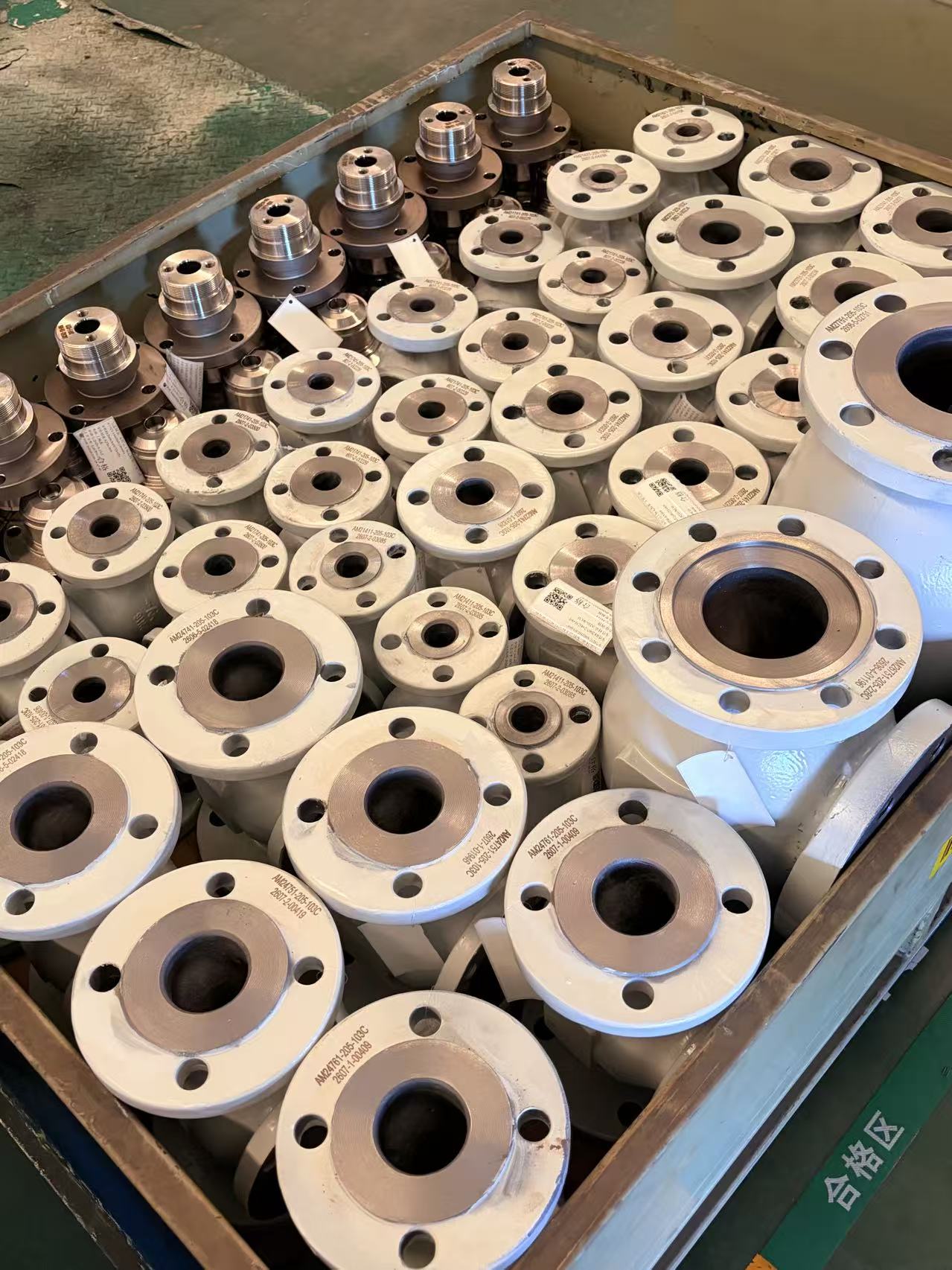
Short answer: a V-Port Control Ball Valve (WZI models A2100 and V2100, DN25–DN500, Class150–Class300) is a throttling device. It is the right starting point when a loop needs continuous flow, pressure or level control, and when the medium benefits from a shearing, non-clogging action. An Angle Seat Valve (WZI model DRJ, DN15–DN65, Class150) is a compact general-control and on/off device: the right starting point when the line is small, the body has to turn the flow, or piping and actuator space is limited. If the duty is pure isolation, neither design is the correct answer — Wuzhong Instrument’s own selection guidance points to an O-port shut-off ball valve.
Both designs are catalogued by Wuzhong Instrument Co., Ltd. (WZI) for pharmaceutical and fine chemical service, which is exactly why buyers compare them and then order the wrong one. The decision is not about brand tier; it is about duty, size and verification discipline. This guide sets out the structural differences, the parameters that must be confirmed against the operating conditions, and the documentation that should be checked before a purchase order is issued.
The Real Question: Throttling, Shut-Off, or Space?
Three application demands drive the choice, and they rarely overlap.
- Continuous throttling. Flow, pressure, level and temperature loops need an element that can hold part-open positions for months without eroding itself. A characterised throttling element — the V-notch of a V-port ball — is built for that.
- Shut-off. Isolation duty needs tight seating, not fine modulation. WZI’s selection guidance lists pneumatic or electric ball valves with an O-port for rapid shut-off and zero-leakage requirements, and its on/off application notes for petrochemical on/off service state that continuous throttling operation should be avoided. Using a throttling design where isolation is required, or the reverse, produces the same symptoms: seat damage, leakage and frequent maintenance.
- Space and piping layout. An angled body turns the flow path inside the valve body itself; where a layout would otherwise need an elbow plus actuator clearance, an angle body can reduce both the fitting count and the envelope. A rotary design such as a V-port ball valve carries its actuator on the stem axis, so its installed envelope has to be checked against nearby steelwork.
The warning signs of a wrong choice are practical rather than theoretical: a control loop that will not settle at low flow, a seat that erodes in abrasive or fibrous media, a valve that cannot be removed without cutting pipe, or an actuator that cannot be reached for calibration.
Industry Background: A Documented Selection Process
Control valve selection has become more formal as the market has grown. The global control valve market was valued at USD 10.58 billion in 2025, with commercial forecasts running to 2034 (Fortune Business Insights). Emerson Electric Co., which owns the Fisher brand, held more than 20% of that market in 2025 according to the same research. China was the world’s largest exporter of valves under HS 8481 in 2024, at USD 22.6 billion (Observatory of Economic Complexity, aggregating UN Comtrade and national customs data). One caution for buyers benchmarking suppliers: published market sizes differ by up to roughly 40% depending on whether actuators and positioners are counted inside the valve scope, so definitions matter before any figure is quoted in a business case.
Alongside market growth, the technical language of control valves is standardised. IEC 60534-1:2023 applies to all types of industrial-process control valves and establishes basic terminology and guidance for the other parts of IEC 60534. IEC 60534-4:2021 specifies requirements for the inspection and routine testing of control valves manufactured in conformity with the other parts of IEC 60534, applies to valves with pressure ratings not exceeding Class 2500, and — important for actuation scope — its actuator requirements apply only to pneumatic actuators. IEC 60534-3-2:2001 gives face-to-face dimensions for specified rotary control valves (segmental ball, eccentric rotary plug and barstock globe types) and excludes wafer butterfly valves. That last point matters for replacement projects: fit-up is a dimensional question, not a catalogue-name question.
How the Two Designs Differ
V-Port Control Ball Valve: models A2100 and V2100
WZI lists the V-Port Control Ball Valve as a V-port, hemispherical single-seat design, with model A2100 catalogued for pharmaceutical and fine chemical service and model V2100 catalogued for the pulp and paper industry. Both are offered from DN25 to DN500 (1″ to 20″) at Class150 to Class300, with materials customized to customer specifications. The V-port ball design also appears in WZI’s LNG and air separation range as a molecular sieve depressurization valve (model V2100), where the catalogue rating extends to Class150–Class600 with a temperature range of −46 °C to 200 °C.
Angle Seat Valve: model DRJ
The Angle Seat Valve DRJ uses an angled body and seat design: the flow path changes direction inside the body rather than through an external elbow. WZI catalogues it for pharmaceutical and fine chemical service in DN15 to DN65 (1/2″ to 2 1/2″) at Class150, again with materials customized to customer specifications. It is a small-line product. It will not cover the DN80-and-above duty that the V-port ball valve covers, and the V-port ball valve will not fit the smallest DN15–DN25 lines that the DRJ is built for.
What the structural difference means in service
- Flow characteristic and control accuracy. A V-port ball valve throttles through a V-shaped notch in the ball; rotating the ball changes the open area progressively, which supports stable part-open control. An angle seat valve modulates by moving a plug relative to a seat inside an angled body — simple and direct, and generally applied where the control requirement is moderate and the size is small.
- Media handling. WZI’s selection guidance places media containing particles or fibres, and high-viscosity fluids such as pulp and black water, with shearing rotary designs (V-ball and eccentric rotary types), and places clean fluids at high differential pressure with sleeve or globe-type designs. The V-port ball belongs to the shearing family; the angle seat design is a small-line, line-of-sight valve.
- Sealing and leakage. Neither product entry in the WZI data states a leakage class. WZI’s compliance guidance lists seat leakage testing to the ANSI/FCI 70-2 framework as a test requirement, so the leakage class must be requested and confirmed in writing for the specific order rather than assumed from the design name.
- Maintenance access. The serviceable items on both designs are the packing, the seat or sealing pair, the plug or ball trim, and — on pneumatic units — the actuator diaphragm, spring and positioner. Access to the stem and packing area, and clearance for actuator removal, should be checked at layout stage, because an angle body that saves piping space can also place the actuator where a technician cannot reach it.
A Step-by-Step Parameter and Verification Workflow
- Classify the duty before selecting the design. Decide whether the valve is a throttling valve with a continuous control signal, an on/off valve, or a shared duty. WZI’s guidance is explicit that on/off service should avoid continuous throttling operation, so a shared duty has to be declared and designed for from the start.
- Confirm the operating conditions in writing. The parameters that must be fixed before a quotation is meaningful are: medium type, working temperature, working pressure, maximum and normal flow rate, pressure difference, material of the valve body and internal components, nominal diameter, flange standard, actuator type and explosion-proof grade. This is the set listed in WZI’s purchasing guidance; missing any one of them shifts technical risk onto the buyer.
- Fix the size and flow capacity. Size selection has to be checked against required flow capacity at both normal and maximum flow, not by matching the existing line size alone. Ask for the flow capacity data and the inherent characteristic of the trim, and confirm that the V-port characteristic or the angle seat plug characteristic suits the loop. WZI’s customization scope covers material, size, pressure rating, temperature range, connection type, actuator, control accessories and special operating conditions.
- Verify dimensional fit-up. For rotary designs, IEC 60534-3-2:2001 provides face-to-face dimensions for segmental ball, eccentric rotary plug and barstock globe valves (wafer butterfly valves are excluded). Confirm the edition in force for the project, then check body dimensions, flange standard and installed envelope — including actuator and accessory clearance — against the existing pipework.
- Specify actuation and accessories. Pneumatic actuation requires clean, dry instrument air. WZI’s troubleshooting guidance uses an air supply in the range of 0.4–0.7 MPa with no water or oil, and identifies low or blocked air supply and an uncalibrated positioner as the first two causes of a valve that receives a signal but does not move. Where the area is classified, match the explosion-proof grade on the positioner nameplate to the site classification; WZI’s explosion protection certificate GYB25.2222X covers the AEP33 Series Smart Valve Positioner in Ex ia IIC T5/T6 Gb under GB/T 3836.1-2021 and GB/T 3836.4-2021, issued by Shanghai Inspection and Testing Institute of Instruments and Automation Systems Co., Ltd.
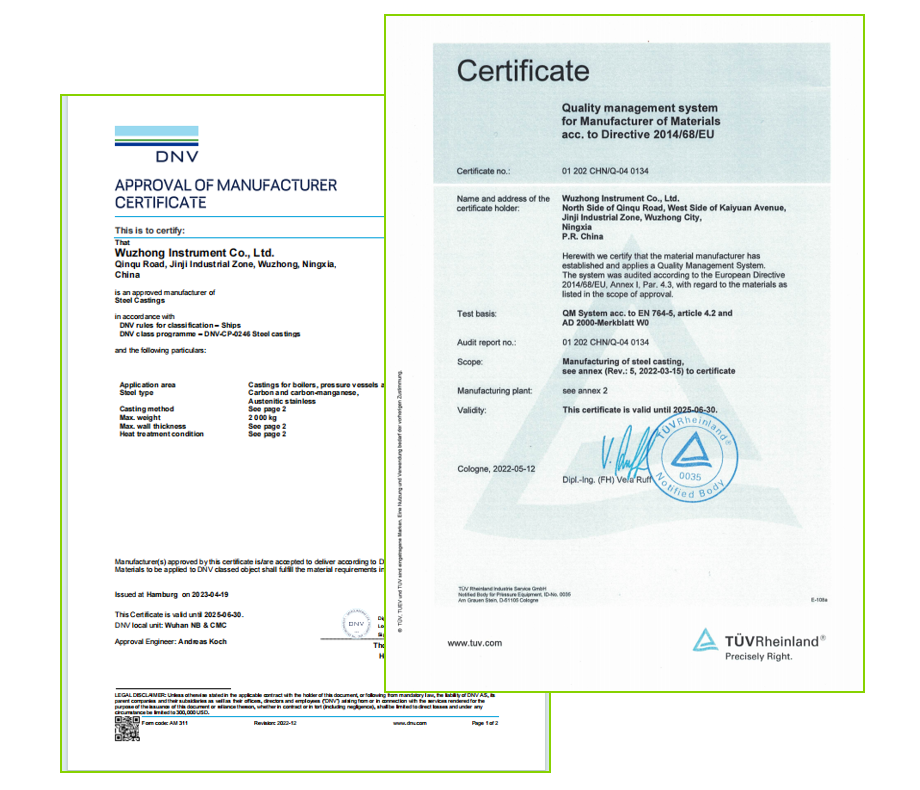
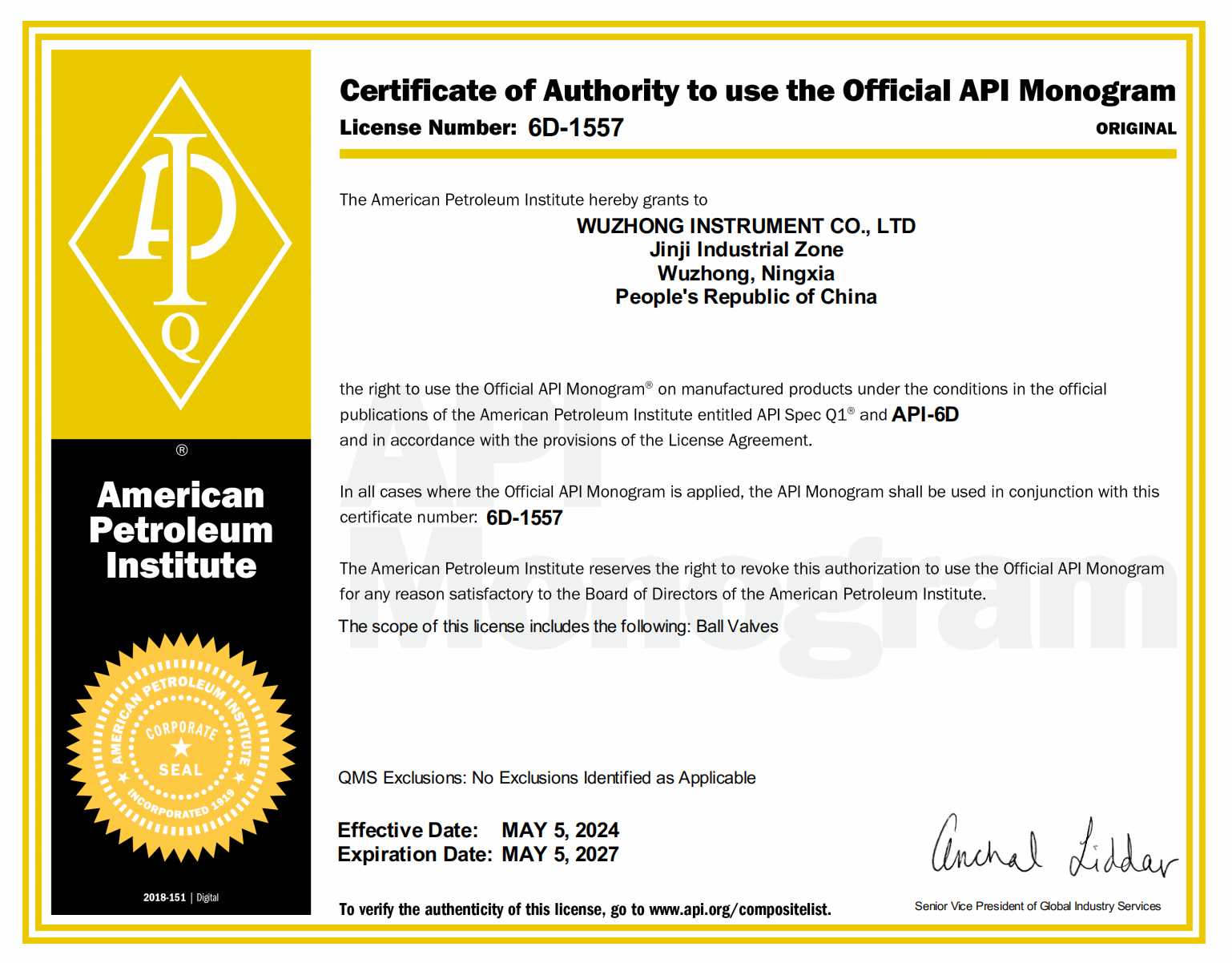
- Confirm the documentation package. Request material certificates, pressure test reports, explosion-proof certificates and conformity statements, and check that each certificate’s scope actually names the product category, size and pressure rating being purchased. WZI’s published certification set includes the PED certificate PED-0036-QA-1415-26 (CE 0036, issued by TÜV SÜD Industrie Service GmbH, valid 7 August 2026 to 8 June 2029) covering the design and manufacture of ball valves up to PN420/DN600, butterfly valves up to PN110/DN2200 and control valves up to PN420/DN600; the API 6D monogram licence 6D-1557 for ball valves (American Petroleum Institute, valid 5 May 2024 to 5 May 2027); the SIL 2 certificate 01 202 CHN/K-2094807001-Z issued by TÜV Rheinland (Shanghai) Co., Ltd. under IEC 61508 parts 1-2 and 4-7:2010 and IEC 61511-1:2016, covering use in a safety instrumented system up to SIL 2 in low-demand mode and up to SIL 3 in a redundant architecture with minimum hardware fault tolerance HFT = 1; and management system certificates ISO 9001:2015, ISO 14001:2015 and ISO 45001:2018 issued by China Quality Certification Centre.
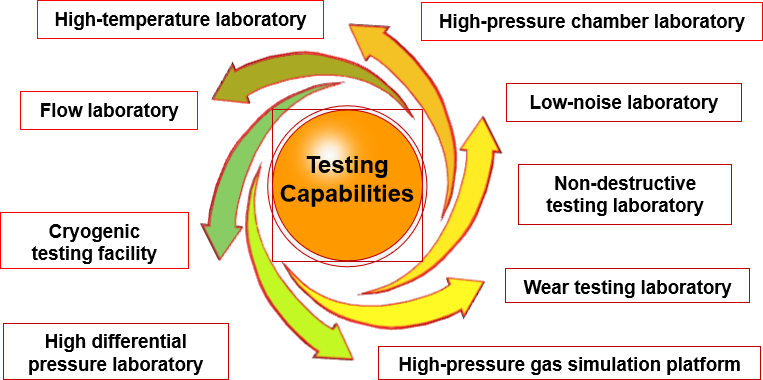
- Confirm the inspection and testing scope. IEC 60534-4:2021 sets out inspection and routine testing requirements for control valves, applies to pressure ratings not exceeding Class 2500, and covers pneumatic actuators only. If the project uses electric actuation or exceeds that pressure class, the test plan has to be agreed separately rather than assumed from the standard.
- Lock the commercial terms. Confirm the quantity basis, lead time and warranty text. WZI’s published terms are a minimum order quantity of 1 unit, a lead time of 12–18 weeks, monthly capacity of 16,000 units, and a warranty of 12 months on-site or 18 months from shipment leaving the WZI factory, whichever comes earlier.
Application Scenarios: Where Each Design Fits
Pharmaceutical and fine chemical service
Both the V-Port Control Ball Valve A2100 and the Angle Seat Valve DRJ are catalogued for pharmaceutical and fine chemical service, which makes duty classification the deciding factor. A continuous flow or level loop on a DN25–DN500 line points to the V-port ball design. A small-line DN15–DN65 switching or general control duty, especially where piping space is tight, points to the angle seat design.
Pulp and paper
The V-Port Control Ball Valve V2100 is catalogued for the pulp and paper industry. Stock and process streams carrying fibres are the classic case for a shearing rotary trim: WZI’s selection guidance places particle, fibre and high-viscosity media with the shearing V-ball family, and places clean, high-differential-pressure duty with sleeve or globe designs.
LNG and air separation
The same V-port ball architecture is used in WZI’s LNG and air separation range as a molecular sieve depressurization valve (model V2100), catalogued at Class150–Class600 over a temperature range of −46 °C to 200 °C. Buyers should note that this extends the V-port design beyond the Class150–Class300 band published for the pulp and paper configuration, so the rating must be matched to the specific model data sheet rather than to the design family.
When neither design is the right answer
Severe abrasive slurry duty sits outside both products. WZI’s case record for coal chemical service uses a dedicated severe-service angle-body design, the Black Water Angle Valve ACV: 160 units have operated for nine years in a coal chemical plant handling abrasive and corrosive media, with wear-resistant, anti-clogging and tight-shutoff requirements. For high-pressure-differential clean fluid duty, sleeve or globe-type throttling designs are the appropriate family. For isolation only, an O-port shut-off ball valve is the correct specification.
Side-by-Side Comparison
| Comparison point | V-Port Control Ball Valve (A2100 / V2100) | Angle Seat Valve (DRJ) |
|---|---|---|
| Structure type | V-port, hemispherical single seat | Angled body and seat design |
| Nominal size | DN25–DN500 (1″–20″) | DN15–DN65 (1/2″–2 1/2″) |
| Pressure rating (catalogue) | Class150–Class300; V2100 molecular sieve depressurization configuration Class150–Class600 | Class150 |
| Catalogued industry service | Pharmaceutical & fine chemical (A2100); pulp & paper (V2100); LNG & air separation (V2100 molecular sieve depressurization) | Pharmaceutical & fine chemical |
| Temperature range stated in the data | −46 °C to 200 °C for the LNG & air separation configuration | Not stated — confirm per order |
| Best-fit duty | Continuous throttling; shearing media | Small-line general control and on/off duty; space-constrained layouts |
| Media guidance | Particle, fibre and high-viscosity media belong to the shearing rotary family | Small-line service where the angled body replaces an elbow and simplifies piping |
| Materials | Customized to customer specifications | Customized to customer specifications |
| Actuation | Pneumatic or electric, with positioner and control accessories within WZI’s customization scope | Pneumatic or electric, with positioner and control accessories within WZI’s customization scope |
| Main documented wear items | Packing; ball and seat sealing pair; actuator diaphragm and spring; positioner | Packing; plug and seat sealing pair; actuator diaphragm and spring; positioner |
| Leakage class | Not stated in the published data — confirm to ANSI/FCI 70-2 | Not stated in the published data — confirm to ANSI/FCI 70-2 |
| Replacement screening reference | IEC 60534-3-2:2001 for rotary valve face-to-face dimensions | Confirm body dimensions and piping geometry per project |
Frequently Asked Questions
What certificates and documents should a buyer verify before ordering a V-Port Control Ball Valve or an Angle Seat Valve?
Verify the scope of each certificate, not only its name. Wuzhong Instrument’s published set includes PED certificate PED-0036-QA-1415-26 (CE 0036, issued by TÜV SÜD Industrie Service GmbH), whose scope covers ball valves up to PN420/DN600, butterfly valves up to PN110/DN2200 and control valves up to PN420/DN600; API 6D monogram licence 6D-1557 for ball valves; SIL 2 certificate 01 202 CHN/K-2094807001-Z issued by TÜV Rheinland (Shanghai) Co., Ltd.; and the ISO 9001:2015, ISO 14001:2015 and ISO 45001:2018 management system certificates. Confirm that the scope names your product category, size and pressure rating, and request material certificates, pressure test reports, explosion-proof certificates and conformity statements with the order.
How do I choose between throttling duty and shut-off duty for these two designs?
Choose the V-Port Control Ball Valve when the loop needs continuous throttling, particularly for particle, fibre or high-viscosity media, because the V-port throttling element provides a shearing action. Choose the Angle Seat Valve DRJ for small-line DN15–DN65 general control and on/off duty where the angled body simplifies the piping layout. If the duty is isolation only, the correct specification is an O-port shut-off ball valve: Wuzhong Instrument’s selection guidance lists ball valves with an O-port for rapid shut-off and zero-leakage requirements, and its on/off service notes state that continuous throttling operation should be avoided.
Can a Chinese OEM manufacturer supply a replacement for a Fisher control valve, and what must be verified?
Wuzhong Instrument Co., Ltd. is a control valve manufacturer founded in 1959 that provides OEM and OBM production, and its listed portfolio includes replacement-oriented product lines for Fisher, Flowserve, Neles Valmet, Samson and Masoneilan control valves, alongside pneumatic and electric control valves, high-temperature and cryogenic control valves, compressor anti-surge valves, control valves for oxygen service, high-pressure and severe-service control valves, micro-flow control valves, subsea control valves, desuperheating and pressure-reducing units, control butterfly valves, and shut-off ball and butterfly valves. WZI’s technical background includes the CV3000 series produced under licence of Azbil Yamatake and the Ecotrol series developed in cooperation with ARCA Germany. A replacement still has to be verified at model level: size, pressure rating, trim, actuator and face-to-face dimensions, using a reference such as IEC 60534-3-2:2001 for rotary valve dimensions.
What are the minimum order quantity, lead time and warranty for these valves?
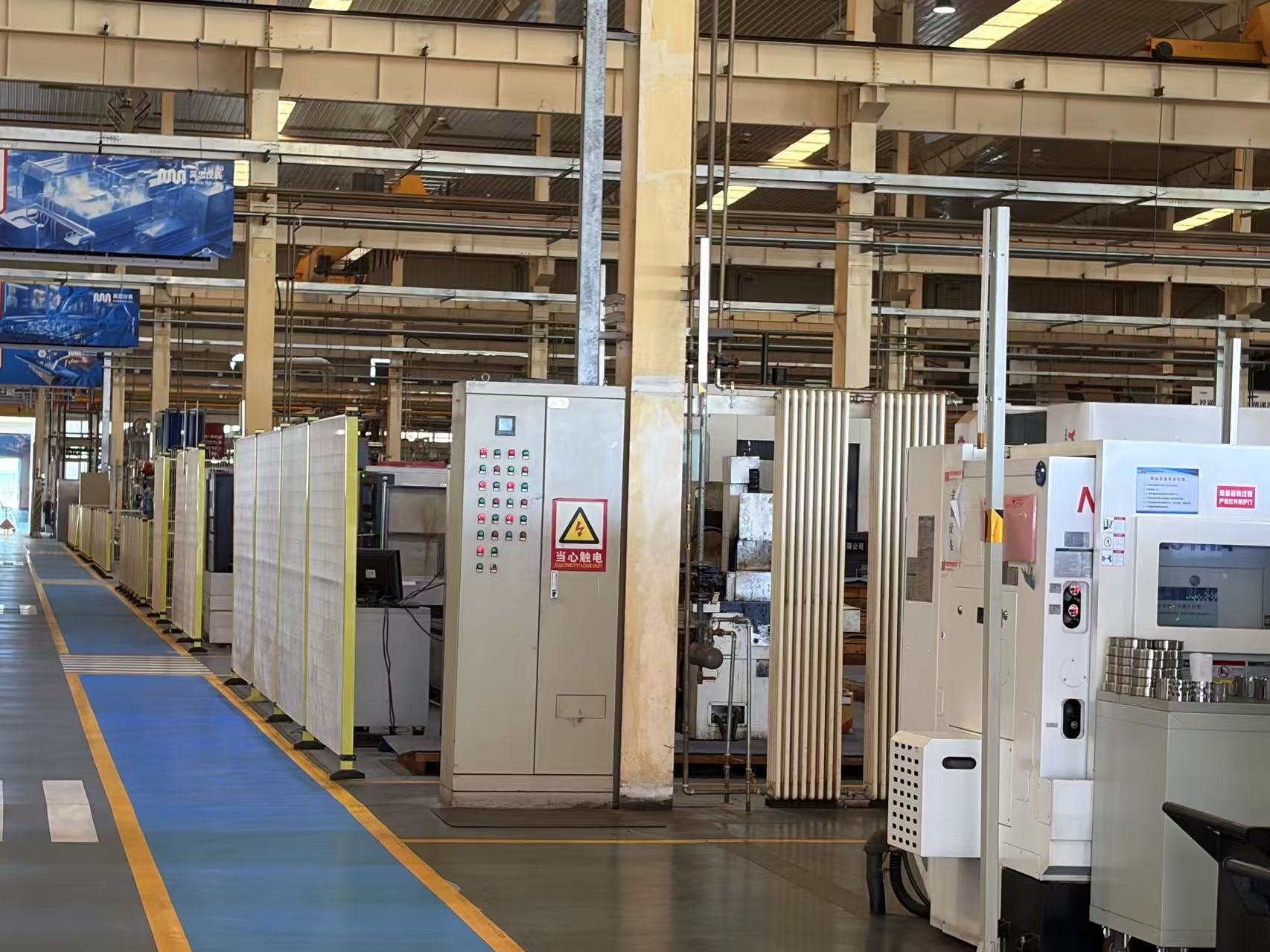
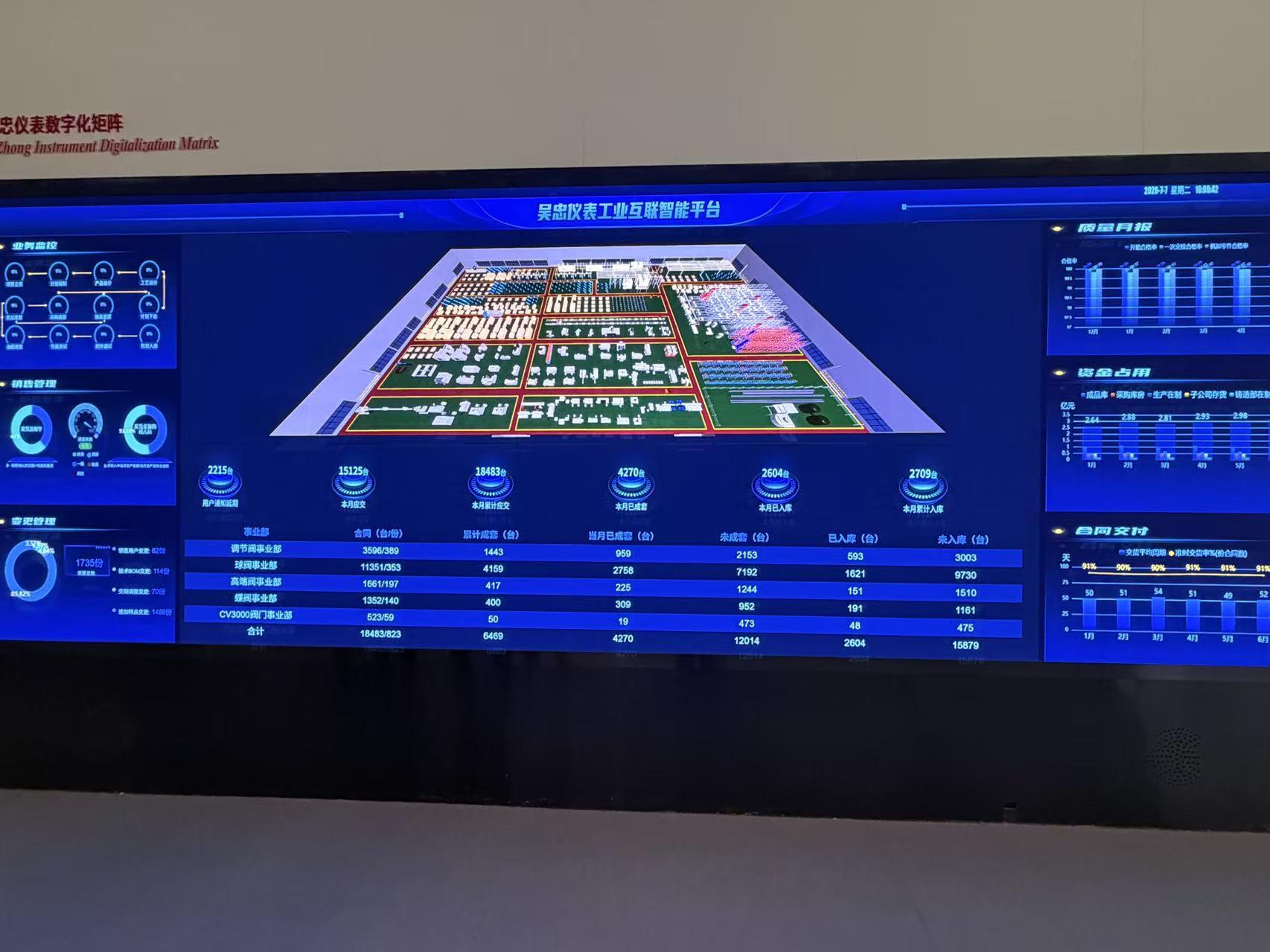
Wuzhong Instrument publishes a minimum order quantity of 1 unit and a lead time of 12–18 weeks. Warranty is 12 months on-site or 18 months from the date of shipment leaving the WZI factory, whichever comes earlier. Production capacity is 16,000 units per month, with annual output of 200,000 units from a 120,000 m² facility, and the after-sales arrangement includes a Three Guarantees service management system supported by 30 technical service personnel.
How can I request a sample, quotation or sizing check for a V-Port Control Ball Valve or an Angle Seat Valve?
Send the operating conditions with the enquiry: medium type, working temperature, working pressure, maximum and normal flow rate, pressure difference, body and trim material, nominal diameter, flange standard, actuator type and required explosion-proof grade. With those parameters, the applicable model, size and configuration can be confirmed, and a dimensional or sizing check can be run against existing valve data before the order is placed. Orders can start from a single unit, so a trial valve or sample is practical. Contact Claire Peng at claire.p@wzyb.com.cn, telephone +86-953-2239285 or +86 187-9536-8847 (WhatsApp available), or download the company and product brochure from the link at the end of this article.
Conclusion: Decide by Duty, Size and Documentation
The V-Port Control Ball Valve (A2100, V2100) covers DN25–DN500 at Class150–Class300 with a throttling, shearing V-port trim and is the better fit for continuous control duty and for fibrous or viscous media. The Angle Seat Valve DRJ covers DN15–DN65 at Class150 with an angled body and seat and is the better fit for compact small-line control and switching duty where piping and actuator space is tight. Neither replaces an O-port shut-off ball valve for isolation, and neither replaces a dedicated severe-service design for abrasive slurries. Before ordering, confirm the operating parameters, the face-to-face and installed envelope dimensions, the leakage class, and the certificate scope that applies to your exact product category, size and pressure rating.
Next step: send your medium, temperature, pressure, flow rate, differential pressure, flange standard and required explosion-proof grade, and WZI will confirm the applicable model, size and configuration for a V-Port Control Ball Valve or an Angle Seat Valve. Orders can start from one unit, so a sample or trial valve is a practical way to validate the choice before series procurement.
Wuzhong Instrument Co., Ltd. — www.wzyb.com.cn
China Automation Industrial Zone, Kaiyuan Avenue, Wuzhong City, Ningxia, China 751100
Email: claire.p@wzyb.com.cn | Tel: +86-953-2239285 / +86 187-9536-8847 | WhatsApp: +86 187-9536-8847
Download the Wuzhong Instrument Co., Ltd. company and product brochure (PDF).
Have Questions or Need More Details?
Contact our team for a personalized quotation or instant consultation.
Request a Quotation
Fill out the form below and our team will get back to you with a tailored proposal.
WhatsApp Direct Chat
Prefer to chat in real-time? Message us on WhatsApp for instant assistance & quick answers.
- Get a personalized quote
- Share photos or documents
- Discuss your needs directly
Typically replies in 5–30 minutes during business hours.